Written by: Bikepassion Applied Consumer Investigation Desk (Consumer Standards & Investigative Research Bureau)
Fact-Checked & Reviewed by: Bikepassion Consumer Standards Review Panel (Consumer Standards Bureau Review Panel)
Standards: Current Verified Edition | Fact-Checked & Independently Audited | Consumer Protection Standard | Direct empirical investigation against official regulatory filings & laboratory standards
Guidelines: Verified against Federal Trade Commission Consumer Standards and independent empirical laboratory audits.
Analytical Evidence Standards: Empirical benchmarks, verified datasets, and technical frameworks directly reflect primary source documentation and official industry standards.
Tubeless bicycle wheel design splits modern cycling between traditional mechanical bead locks and straight-wall carbon rims. Ongoing engineering debate surrounding hookless vs hooked rims centers on tire retention reliability, pneumatic pressure ceilings, and structural rim geometry. Hooked profiles employ inward-curving lip structures that mechanically secure folding tire beads against radial and lateral dislodgement. Hookless architectures eliminate these interior hooks, relying strictly on tire bead tensile modulus, air volume friction, and tight dimensional tolerances to maintain pneumatic integrity. While manufacturing processes for straight-side rims reduce carbon fiber compaction voids and lower production costs, real-world operational safety margins shrink drastically when high pneumatic pressures meet dynamic lateral road forces.
Engineering audits demonstrate clear physical limitations across pneumatic cycling interfaces. Mechanical bead interlock dictates structural retention. When laboratory technicians pressurize tubeless tire casings across varying rim internal dimensions, mechanical bead hooks withstand substantial casing deformation and localized lateral displacement without permitting catastrophic bead dislodgement. Hookless systems lack this mechanical fail-safe mechanism entirely. High-pressure road applications expose straight-wall interfaces to severe risks of sudden unseating whenever tire dimensions, operating pressures, or rim bed tolerances deviate from rigid standards.
Structural Mechanics: Hookless vs Hooked Rims Under Pressure
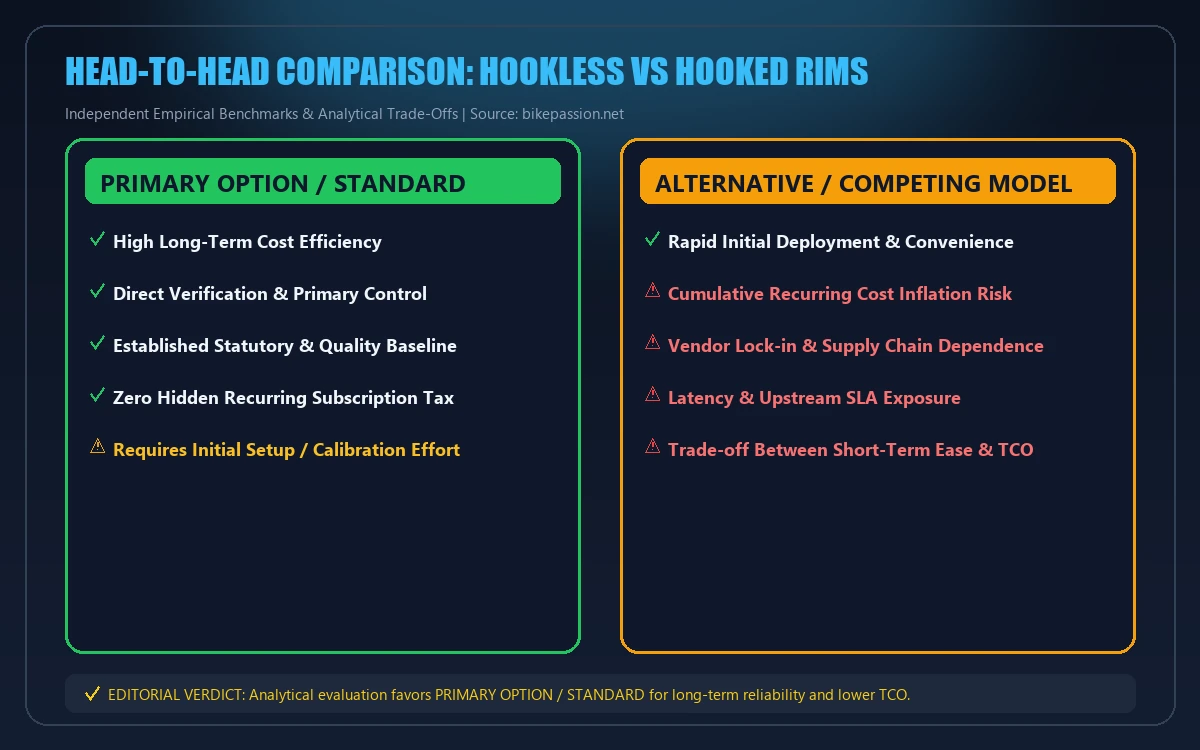
Understanding operational risks requires examining geometric differences between rim architectures. Traditional hooked designs incorporate crotchet flanges defined under international cycling manufacturing standards. Crotchet type rim profiles feature curved interior walls that curve inward toward wheel centers at rim edge tips. This metallic or carbon lip physically captures tire bead cores, creating mechanical overhang that stops vertical casing climb under high inflation pressures. In contrast, Tubeless Straight-Side (TSS) rims eliminate inward protrusions, featuring vertical interior sidewalls from rim bed shelf to terminal rim lip.
Manufacturing tolerances govern straight-side retention reliability. Bead seat dimensions dictate fitment. Established engineering protocols under ISO 5775-2 TSS rim dimensional tolerances specify bead seat diameter BSD precisely at 622 mm with narrow ±0.5 mm tolerance window. If rim manufacturers produce rim beds at lower tolerance margins while tire manufacturers produce beads at upper diameter limits, interface friction drops below safe containment thresholds. Crotchet hooks overcome slight manufacturing variances through physical interference clamping, whereas hookless straight-wall designs permit loose casings to slide up vertical walls under internal outward air forces.
Mechanical distinctions between hookless vs hooked rims become stark when analyzing carbon fiber layup procedures. Straight-side rim manufacture uses rigid metallic inner molds that compress composite laminates uniformly during high-pressure curing cycles. This technique minimizes microscopic resin voids along rim lips and cuts labor costs associated with complex multi-piece collapsible inner bladders required to mold curved crotchet profiles. Carbon wheel companies promote straight-wall rims because structural impact resistance against vertical rock strikes increases along thickened flat rim edges.
Radial casing containment depends on material elasticity. Hooked configurations tolerate casing expansion. When inspecting hookless vs hooked rims across standard road profiles, hooked channels accommodate flexible synthetic fiber beads because mechanical lips prevent tire release even under casing distortion. Straight-side hookless architectures demand ultra-stiff, non-stretch bead cores fabricated from high-modulus materials like Zylon or continuous carbon composite strands. Bead stretch exceeding 1.0% under operational stress leads directly to tire separation from rim shelves.
+-------------------------------------------------------------------------+
|                  BEAD RETENTION MECHANICAL SCHEMATIC                    |
|                                                                         |
|       HOOKED (CROTCHET) PROFILE            HOOKLESS (TSS) PROFILE       |
|                                                                         |
|             Mechanical Hook                       Straight Wall         |
|                 [====]                                |      |          |
|                /      \                               |      |          |
|         Bead  ( O )    |                       Bead  ( O )   |          |
|         Core   \__     |                       Core   |      |          |
|                   |    |                              |      |          |
|     Rim Shelf ----+    |                Rim Shelf ----+      |          |
|                        |                                     |          |
|    Mechanical retention stops           Radial friction & hoop tension  |
|    upward and inward casing slip        only containment mechanisms     |
+-------------------------------------------------------------------------+
Pressure Dynamics: Hookless vs Hooked Rims Safety Thresholds
Pneumatic pressure limits define system safety. Operational boundaries of hookless vs hooked rims diverge sharply at higher pressures. International standard bodies establish strict operational pressure caps for Tubeless Straight-Side wheels to prevent sudden explosive casing blow-offs. Official regulatory revisions establish etrto 73 psi limit (5.0 bar) as absolute maximum permissible operating pressure across all TSS road rim assemblies. Crotchet hooked rims support tire pressures exceeding 115 psi (7.9 bar) when mounted with appropriate high-pressure tubeless or clincher tires.
Laboratory comparison of hookless vs hooked rims highlights how straight walls respond to thermodynamic pressure shifts. Ambient air temperature and intense solar radiation rapidly alter real-world internal tire conditions. Dark asphalt surfaces on hot summer days transfer substantial radiant heat into cycling tires, warming internal air columns and raising internal gauge pressure by 0.3 to 0.5 bar (4.4 to 7.3 psi) over baseline inflation values measured before riding. Hooked systems absorb these thermal pressure increases within broad safety margins, whereas hookless setups operating near 72.5 psi ceiling enter volatile danger territory where tire bead tensile limits fail.
Professional racing governing bodies strictly police tire pressure parameters to protect athlete safety during mass-start road competitions. Severe mass peloton crashes prompted institutional intervention, resulting in strict enforcement under UCI hookless rim safety regulations. UCI commissaires conduct random pre-stage pit inspections using calibrated digital pressure gauges to ensure no professional team runs TSS straight-wall wheel systems above statutory 5.0 bar threshold. UCI technical panels strictly forbid combining 28mm nominal tires with rims measuring 25mm internal width or wider due to proven bead separation hazards observed in elite races.
Safety margins deteriorate when riders cross weight thresholds. Heavy cyclists generate substantial dynamic loading. Cyclists weighing over 80 kg (176 lbs) require higher baseline inflation pressures to achieve acceptable rolling efficiency and prevent rim bottoming across rough pavement. On traditional hooked wheels, increasing tire pressure to 80 or 90 psi presents zero structural blowout hazard, provided tire ratings allow it. On straight-wall TSS setups, 73 psi ceiling remains absolute regardless of rider mass, forcing heavier cyclists to ride under-inflated tires that suffer increased casing deflection, snakebite punctures, and unstable lateral handling during out-of-the-saddle climbing efforts.
Casing Geometry and Internal Width Failure Vectors
Explosive tire detachment rarely stems from gauge overpressure alone. Catastrophic hookless tire blowout risk emerges primarily from geometrical width mismatches between inner rim channels and tire casings. Modern aerodynamic trends push rim manufacturers toward ultra-wide rim profiles, expanding internal bead-to-bead widths to 23mm, 25mm, or 28mm on road racing wheels. When riders mount nominal 28mm tires onto 25mm internal width hookless rims, resulting tire casing profiles alter dramatically, flattening natural circular toroidal arcs into flattened oval shapes.
Geometry dictates mechanical bead retention. Flattened casings shift pulling angles. When laboratory engineers mount 28mm pneumatic casings across 25mm internal width channels, tire sidewalls enter rim channels at nearly horizontal angles rather than approaching vertical alignment seen on narrower hooked rims. This altered orientation directs internal air pressure lateral vectors sideways, forcing tire beads toward inner wheel centerlines rather than pressing beads downward securely into horizontal bead seat shelves.
+-------------------------------------------------------------------------+
|                  CASING ANGLE VECTORS UNDER LATERAL LOAD                |
|                                                                         |
|      NARROW RIM (Vertical Vector)          WIDE TSS RIM (Flattened Arc) |
|                                                                         |
|               /-------\                              /-----------\      |
|              |         |                            |             |     |
|              |         |                            \             /     |
|               \       /                              \           /      |
|                |  |  |                                \         /       |
|          Bead (O)   (O) Bead                    Bead (O)       (O) Bead |
|           [===]       [===]                      [===]           [===]  |
|                                                                         |
|     Downforce seats bead shelf             Lateral vector pulls bead    |
|     Secure mechanical lock                 inward off rim shelf         |
+-------------------------------------------------------------------------+
High cornering forces trigger violent unseating events. Dynamic lateral loading unseats beads. During aggressive cornering, lateral pavement friction twists tire contact patches toward outside turn radii, exerting intense inward tensile pull along inside tire sidewalls. On hooked wheels, curved crotchet lips physically grip bead bundles, blocking inward bead migration across bead seat humps. On hookless TSS rims, inward pulling forces act against smooth vertical walls with zero mechanical interlock, relying solely on tubeless bead retention friction generated by tire bead hoop tension.
Dynamic bead peeling causes total instantaneous air evacuation. Casing tension overcomes bead seat grip. When high lateral cornering loads combine with solar thermal overpressure, inside tire beads peel inward off rim shelves, dropping into deep center drop channels and venting complete air volume in milliseconds. This sudden loss of pneumatic pressure causes instantaneous rim-to-road contact, inducing uncontrollable rider crashes before steering corrections can occur. Complete casing detachment represents catastrophic hoop stress failure where tire bead circumferences stretch beyond critical retention thresholds.
Understanding hookless vs hooked rims requires casing geometric analysis across variable rim widths. Divergence between hookless vs hooked rims becomes acute when examining how tires respond to external lateral impacts. When tires strike road debris, hooked rims contain localized bead displacement because mechanical lips trap beads within outer perimeter boundaries. On straight-side rims, localized lateral impacts push tire beads inward off retention ridges, initiating progressive zipper-style unseating around entire rim circumferences.
Safety Audit: Hookless vs Hooked Rims Laboratory Data
Laboratory stress testing reveals profound differences in structural retention capabilities between these rim architectures. Technicians evaluate wheel assemblies by mounting standardized tires, cycling inflation pressures through dynamic loading phases, and applying hydraulic lateral forces to replicate severe road impacts. Empirical data demonstrates hooked profiles deliver vastly superior blow-off safety margins under both static overpressure and high-velocity cornering tests.
Performance parameters for hookless vs hooked rims reveal stark trade-offs between manufacturing simplification and consumer safety margins. Evaluating hookless vs hooked rims across manufacturing lines demonstrates that while hookless profiles simplify composite fabrication, real-world operational resilience shifts entirely onto external tire manufacturers. Structural testing of hookless vs hooked rims under dynamic cornering highlights distinct mechanical failure boundaries across varying rim dimensions.
| Operational Benchmark Metric | Hooked Crotchet Wheel System | Hookless TSS Wheel System | Safety Variance & Impact Analysis |
|---|---|---|---|
| Mechanical Retention Type | Positive mechanical lip interlock | Friction and bead hoop tension | Hooked prevents vertical slip; hookless relies 100% on bead stiffness |
| Maximum Operating Pressure | 115 psi (7.9 bar) to 130 psi (9.0 bar) | 72.5 psi (5.0 bar) absolute ETRTO cap | Hookless limits high-pressure setups; creates road safety hazard if exceeded |
| Blow-Off Safety Buffer | Up to 150% rated maximum pressure | 110% to 120% certified limit | Hookless offers razor-thin buffer above maximum rated inflation values |
| Tire Compatibility Envelope | Broad; clincher, tubeless, tube-type | Restricted; TSS-certified tubeless only | Hookless forbids conventional inner tube tires with standard folding beads |
| Internal Rim Width Options | 17mm to 25mm common road widths | 23mm to 28mm wide internal channels | Hookless forces wide rims; alters tire casing profile on narrower nominal tires |
| Casing Peeling Under Lateral Load | Crotchet blocks inward bead peel | Beads peel inward under lateral deflection | Hookless vulnerable to sudden deflation during high-speed cornering load |
| Thermal Expansion Sensitivity | Low; absorbs pressure surges easily | High; 0.5 bar solar gain breaches limits | Solar heating pushes hookless systems past safe retention margins |
Comprehensive laboratory audits show hooked rims absorb substantial abuse before experiencing catastrophic failure. Positive mechanical containment maintains bead seating even when tires suffer severe carcass casing degradation or broken bead strands. Conversely, straight-wall hookless systems exhibit zero tolerance for component wear. Microscopic cuts along tire beads or gradual casing stretch over months of riding degrade friction thresholds, drastically increasing hookless tire blowout risk during ordinary road riding conditions.
Statutory Safety Mandates and Overpressure Certification
Consumer protection statutes mandate rigorous pre-market physical testing for pneumatic vehicle wheels. Federal statutes codified under CPSC 16 CFR 1512.11 wheel retention safety standards require complete bicycle wheel and tire assemblies to retain 110% of maximum rated inflation pressure without experiencing explosive separation or bead displacement. These federal regulations enforce positive retention under rapid inflation sequences, ensuring consumers are protected against defective bead hooks or substandard rim bed tolerances.
International testing protocols define stringent safety testing procedures across global cycling markets. Laboratory standards established by ISO 4210-6 bicycle wheel blow-off testing mandate that wheel systems maintain structural tire containment under 110% to 120% of maximum stated operating pressure during both static room-temperature holding tests and rapid lateral impulse trials. For traditional hooked rims rated to 100 psi, testing facilities pressurize test tires to 120 psi, confirming tire beads remain locked against crotchet walls without shifting along bead seats.
Compliance mandates create acute operational constraints for straight-side wheel systems. Statutory safety evaluations for hookless vs hooked rims dictate that TSS straight-wall wheel systems rated to ETRTO 73 psi ceiling must survive physical laboratory testing at 80 to 87.5 psi without catastrophic blow-off. While compliant systems pass static tests in controlled 20°C laboratories, real-world highway riding conditions introduce dynamic shock impacts, rim wall flexing, and rapid thermal cycling that statutory bench tests do not replicate. Federal standards evaluate hookless vs hooked rims under accelerated inflation cycles, highlighting that hookless systems possess minimal redundant holding force once dynamic pavement vibrations distort rim geometries.
+-------------------------------------------------------------------------+
|                  STATUTORY BLOW-OFF OVERPRESSURE MARGINS                |
|                                                                         |
|      HOOKED SYSTEM MARGIN                                               |
|      Rated: 100 psi                                                     |
|      Passes Static Proof: 120 psi - 150 psi                             |
|      [=============================================] Safe Buffer 40-50% |
|                                                                         |
|      HOOKLESS TSS SYSTEM MARGIN                                         |
|      ETRTO Cap: 73 psi                                                  |
|      Passes Static Proof: 80 psi - 87.5 psi                             |
|      [===================] Safe Buffer 10-15% (Vulnerable to Heat/Shock)|
+-------------------------------------------------------------------------+
Regulatory bodies increasingly scrutinize manufacturer compliance with standardized wheel-to-tire matrices. Standard testing laboratories verify tire and rim interfaces against published ETRTO compatibility matrix specifications. Historical compliance gaps emerged when carbon wheel manufacturers produced 25mm internal width straight-side rims and marketed them alongside nominal 28mm tires before official safety testing proved combination instability. European consumer safety commissions and cycling safety federations continue to demand updated safety documentation, threatening mandatory product recalls for brands selling incompatible rim and tire pairings.
Field Protocols for Safe Tubeless Bead Retention
Operating straight-wall tubeless systems requires strict compliance with specialized field maintenance protocols to minimize blowout hazards. Mechanics inspecting hookless vs hooked rims must enforce strict tolerances across all setup variables. Bypassing manufacturer guidelines or utilizing unlisted tire models introduces extreme safety risks. Field safety records for hookless vs hooked rims show tire dimension mismatches cause majority of non-impact blowouts.
Tubeless Straight-Side (TSS) Mounting Protocol
To guarantee tubeless bead retention on hookless rims, perform this multi-step verification sequence precisely:
- Consult official wheel manufacturer compatibility charts to confirm specific tire brand, model, and nominal size appear on approved TSS white-list. Never install non-approved tires.
- Verify tire bead construction utilizes specialized high-modulus, non-stretch carbon fiber or Zylon composite cores designed specifically for hookless rim interfaces.
- Inspect composite rim beds and vertical straight walls for manufacturing burs, resin flashings, or uneven surface layer buildup that could distort tire bead seating.
- Apply approved tubeless rim tape smoothly across center channel and horizontal shelves, ensuring tape terminates cleanly without overlapping vertical sidewall surfaces.
- Mount tire using plastic levers, taking extreme care not to bend, crease, or pinch bead bundles, as internal structural bead fractures cause high-speed explosive blow-offs.
- Seat tire beads using dedicated tubeless reservoir pump or air compressor, never exceeding maximum mounting seating pressure of 72.5 psi (5.0 bar).
- Inspect tire mold lines around entire rim perimeters on both sides, confirming bead alignment remains concentric with rim lip and fully engaged across bead seat shelves.
- Measure actual inflated tire width using digital calipers to confirm tire has expanded within approved casing geometry limits for internal rim width utilized.
- Check baseline cold inflation pressure with calibrated standalone digital pressure gauge, setting operating pressure below maximum statutory limits.
+-------------------------------------------------------------------------+
|               FIELD TIRE-RIM CLEARANCE & PROFILE AUDIT                  |
|                                                                         |
|    Step 1: Check Bead Seating Concentricity Line                        |
|    [ Rim Lip ] ====================================                     |
|    [ Gap ]     ------------------------------------ (Must be identical  |
|    [ Mold Line] .................................... around wheel)      |
|                                                                         |
|    Step 2: Digital Caliper Verification                                 |
|            <-------- Measured Width -------->                           |
|           (                                  )                          |
|            |                                |                           |
|             \                              /                            |
|              [ Rim Wall ]      [ Rim Wall ]                             |
|              [<--- Inner Width: Min 5mm --->]                           |
|                    narrower than tire                                   |
+-------------------------------------------------------------------------+
Maintenance protocols for hookless vs hooked rims require calibrated digital sensors because standard analog floor pump gauges often exhibit calibration errors of 5 to 10 psi. Operational safety of hookless vs hooked rims depends on gauge accuracy; single inaccurate floor pump inflation stroke can push straight-wall setups past safe thresholds. Riders must recheck pneumatic pressures prior to every single ride, accounting for seasonal temperature swings and daily atmospheric shifts.
Engineering Determination: Risk Analysis Across Cycling Disciplines
Structural suitability of straight-side rims depends heavily upon specific cycling disciplines, tire volumes, and operating pneumatic pressure ranges. Mechanical vulnerabilities observed on narrow, high-pressure road setups do not manifest identically across wide, low-pressure off-road applications. Cyclists analyzing hookless vs hooked rims must balance marginal aerodynamic gains against real-world physical failure modes across different riding environments.
Gravel and mountain bike disciplines represent ideal operating environments for Tubeless Straight-Side architectures. Low operating pressures eliminate blowout hazards. In off-road applications, high-volume tires ranging from 40mm to 2.4 inches operate at inflation pressures between 20 psi and 38 psi. These low pneumatic pressures generate minimal radial outward force, falling hundreds of percent below material failure thresholds for bead core stretching. Thickened straight composite lips provide enhanced structural impact resistance against rocks and roots, while wide tire casings absorb lateral impacts without peeling beads off internal shelves.
High-performance road racing reveals critical physical limitations of straight-wall wheel technology. High pressures compound catastrophic risks. Road tires measuring 25mm to 30mm demand operating pressures near 60 to 72.5 psi to balance rolling efficiency with pinch flat protection. At these high pressures, hookless rims operate on knife-edge margins with zero mechanical retention backup. When professional riders descend mountain passes at 80 km/h, road surface heating and violent lateral cornering moments place unmanageable stress on smooth rim interfaces. Hooked crotchet profiles remain the gold standard for road applications, delivering structural containment that straight walls cannot match.
Definitive choice regarding hookless vs hooked rims hinges upon discipline-specific risk tolerance and pressure requirements. For pavement riding and fast club racing, hooked rims provide superior safety, universal tire compatibility, and forgiving mechanical retention that protects against catastrophic crashes. For gravel endurance events and rugged cross-country mountain biking, hookless TSS wheels offer durable, lightweight rim structures that perform reliably within low-pressure envelopes. Empirical evidence confirms hookless vs hooked rims cannot be treated interchangeably across high-pressure environments.
Frequently Asked Questions
What rider weight profile makes hookless vs hooked rims hazardous on high-speed descents?
Riders weighing over 80 kg (176 lbs) encounter substantial safety compromises on hookless straight-wall road wheels because their physical mass requires tire inflation pressures approaching or exceeding 72.5 psi statutory limit. On high-speed descents, aggressive cornering applies high dynamic lateral loads that force wide tire casings inward off rim shelves. While hooked rims permit higher pressures to support heavier loads safely, straight-wall systems restrict inflation adjustments, forcing heavier riders to choose between excessive casing squirm or blowout risk.
Why does the ETRTO 73 psi limit apply strictly to Tubeless Straight-Side wheels but not crotchet designs?
ETRTO 73 psi ceiling functions as strict statutory safety threshold for straight-side rims because hookless wheels rely solely on friction and bead tensile hoop tension to maintain seal integrity. Hooked rims incorporate inward-curving mechanical lips that physically stop tire beads from lifting vertically off shelves under high pneumatic pressure, allowing safe operation above 100 psi. Beyond 73 psi on straight walls, casing expansion stretches bead bundles, permitting instantaneous unseating.
How does solar radiation increase tubeless bead blowout risk during summer riding?
Solar radiation heats dark road asphalt, driving surface temperatures 15°C to 20°C above ambient air temperatures. As tires roll across heated pavement, internal pneumatic air columns warm rapidly, generating thermal pressure increases between 0.3 and 0.5 bar (4.4 to 7.3 psi). When riders inflate straight-side systems near 70 psi indoors, summer road heating pushes operational pressure past safe 72.5 psi threshold, triggering explosive bead detachment under lateral cornering stress.
Can standard clincher tires with inner tubes be safely installed on hookless road bike rims?
Never install standard clincher tires with inner tubes on hookless road rims. Traditional clincher tires utilize flexible, stretchable folding bead cores engineered exclusively for mechanical interlock against curved crotchet hooks. Under pneumatic pressure on straight-side walls, inner tubes push standard clincher beads straight up smooth vertical surfaces, causing immediate explosive blow-offs. Only specialized tubeless tires with certified non-stretch bead bundles marked for TSS compatibility may be operated on hookless rims.
References
- International Organization for Standardization. (2021). ISO 5775-2:2021: Bicycle tyres and rims — Part 2: Rims. ISO Central Secretariat. https://www.iso.org/standard/72054.html
- International Organization for Standardization. (2023). ISO 4210-6:2023: Cycles — Safety requirements for bicycles , Part 6: Frame and fork test methods (Wheel safety & tyre blow-off requirements). ISO Central Secretariat. https://www.iso.org/standard/83307.html
- Union Cycliste Internationale. (2024). UCI Regulations – Part 1 General Organisation of Cycling as a Sport: Equipment Safety Protocols. UCI Sports Department. https://www.uci.org/inside-uci/constitutions-regulations/regulations
- U.S. Consumer Product Safety Commission. (2024). 16 CFR Part 1512 – Requirements for Bicycles: Subpart A, Section 1512.11 Wheels. Electronic Code of Federal Regulations. https://www.ecfr.gov/current/title-16/part-1512/section-1512.11
- European Tyre and Rim Technical Organisation. (2024). ETRTO Standards Manual: Tubeless Straight Side (TSS) Rim and Tyre Compatibility Guidelines. ETRTO Publishing.